Island hopping with ashes, bones, and words
Malta is located at about 90 kilometres from Sicily. You can’t see it from the horizon unless you reach higher ground. Getting there by canoe takes over twenty-four hours, which means navigating through the night, steering by the stars.
An article by Michael Marshall published this week in Internazionale, an Italian weekly review, reports what happened when archaeologist Eleanor Scerri excavated Latnija cave in northern Malta: she found hearth ash, stone tools, deer bones bearing butchery marks. Radiocarbon dating places these traces at 8,500 years ago, a full millennium earlier than previously thought. But the real shift is something else: these were hunter-gatherers, the people the scientific community had long assumed incapable of crossing open sea. The study, published in Nature in 2025, forced a rewrite not just of Malta’s prehistory but of the entire chronology of Mediterranean seafaring.
Marshall’s article tracks the evidence piling up worldwide: obsidian from the island of Melos found in Franchthi cave, dated to 13,000 years ago; stone tools on Greek islands possibly reaching back 200,000 years; the arrival of humans in Australia at least 50,000 years ago, which could only have happened by sea. Intentional navigation is far older than we assumed, and the material traces — bones, ash, worked stone — are how archaeology has managed to prove it.
There is another way, though, to reconstruct prehistoric voyages: linguistics, which tells us about seafarers from a not much later period, on the other side of the world.
The Saisiyat are one of Taiwan’s indigenous peoples. In their language, the word for “thank you” is ma’alo’. In Hawaii, nine thousand kilometres away, the word for “thank you” is mahalo. The connection does not appear to be coincidental. Linguist Robert Blust, at the University of Hawaii, started from a simple observation and built a theory with enormous implications. Of the roughly 1,200 Austronesian language variants (20 per cent of all human languages) nine out of ten subgroups are found only in Taiwan. Blust argued that the largest maritime migration in human history began right there.
I came across this story while translating Jonathan Clements’ Rebel Island, a history of Taiwan published in Italy by EDT. Clements places it at the end of the book, in the final chapter, because Blust’s theory only gained traction in recent decades. The sequence he reconstructs runs like this: roughly five thousand years ago, people from what is now southern China crossed the Taiwan Strait, until then impassable. On the island they developed the navigational skills needed to set out again, a thousand years later, along the Batan island chain towards the Philippines, and then across the rest of the Pacific: Indonesia, Micronesia, Malaysia, as far as Madagascar to the west, and around 800 AD, in the opposite direction, all the way to Hawaii and Easter Island. Among his supporting evidence, Blust pointed to Austronesian words for things that existed in Taiwan - plants, animals, “cold weather” - but that did not exist at all in the places of arrival, thousands of kilometres to the south.
Two independent stories, different seas, peoples who knew nothing of each other. Archaeology uncovers a meal cooked eight thousand years ago on an island no one thought reachable; linguistics traces a single word across nine thousand kilometres and five thousand years. Different methods of inquiry converge on the same conclusion: the ability to cross the sea, and the courage to do it, are far older than we believed.
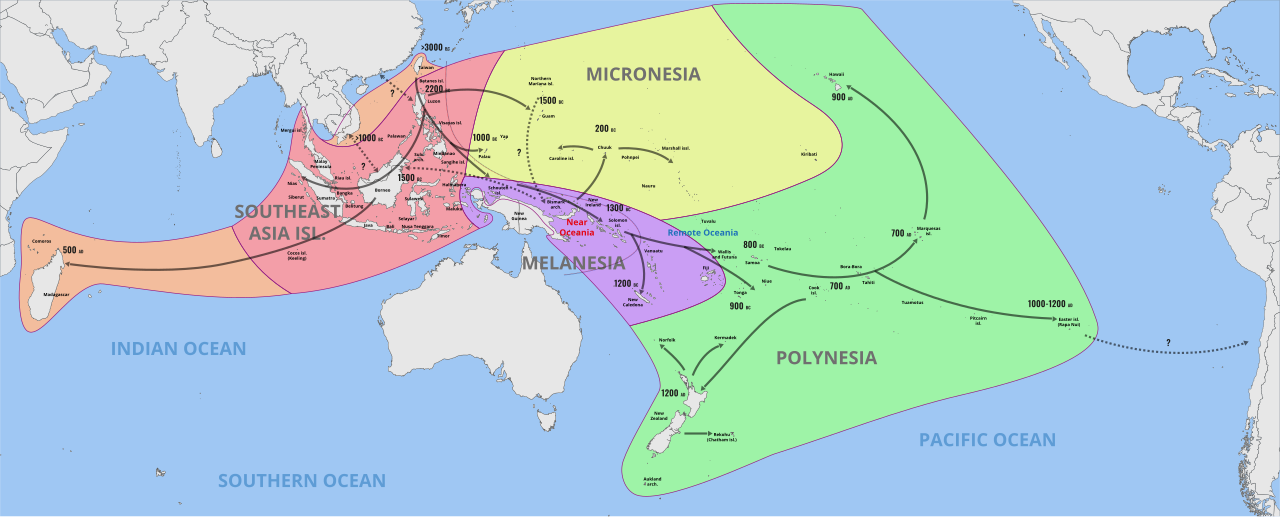
Chronological dispersal of Austronesian people across the Pacific
There is a warning in Clements’ book worth remembering. The theory of Taiwanese origin is potentially appealing to those with geopolitical interests: a single fabricated study in the right journal could turn a linguistic discovery into a territorial claim by China over thirty-seven sovereign states, from the Solomon Islands to Fiji.
Ancient stories can have modern consequences. The way we tell them is never neutral.
Top photo by Dr Huw Groucutt, University of Malta. Map by Wikimedia user Pavljenko.